There is no courtesy for spoilers with “Bugonia.” This film collapses without them. To discuss it honestly means saying exactly where it goes, what it validates, and how thoroughly it betrays the only coherent readings it briefly allows.
Yorgos Lanthimos is a filmmaker of formidable technical control. He understands framing, tone, and how to extract astonishingly precise performances from actors willing to walk a tonal tightrope, and he has made a few genuinely great films. But “Bugonia” is not one of them. Once again, Emma Stone and Jesse Plemons deliver master-class work. Disciplined, committed, exacting. Line by line, beat by beat, they do everything asked of them. That the film functions at all on a moment-to-moment basis is a testament to their talent.
And yet “Bugonia” amounts to practically nothing.
Not nothing in the fashionable, ambiguity-as-virtue sense. Not nothing because characters fail to change or arcs remain unresolved. Those are not sins. I mean nothing in the more damning sense: no story, no interior logic, no philosophical spine. Just repetition, gesture, and poppycock nonsense mistaken for meaning.
The premise is already precarious. A man abducts a powerful corporate executive, convinced she belongs to some alien or conspiratorial force bent on humanity’s destruction. Absurdity is not the problem. Absurdity can be fertile. But even the strangest films must obey the laws they establish. “Bugonia” does not establish them, does not honor them, and does not seem to care.
Start with the most basic question: where does this film take place? It gestures vaguely toward “anywhere,” but not in a mythic or symbolic sense. It feels more like a production that could not be bothered to decide, or worse, one that picked locations based on tax incentives. The license plates clarify nothing. The geography has no texture. “Anytown, USA” only works if the film understands what it is abstracting. “Bugonia” does not. It floats in a non-place not as a deliberate abstraction but as a failure of commitment. Just pick a place. That is all it would have taken.
This indifference to coherence infects everything. The abducted woman is implied to be enormously powerful, the head of a major corporation whose disappearance would trigger a global response. Yet the world around her behaves as if power, scale, and consequence barely exist. The film gestures toward systems such as law enforcement, corporate authority, and public scrutiny, but never allows them to exert real pressure. Events happen because the script needs them to, not because the world demands them.
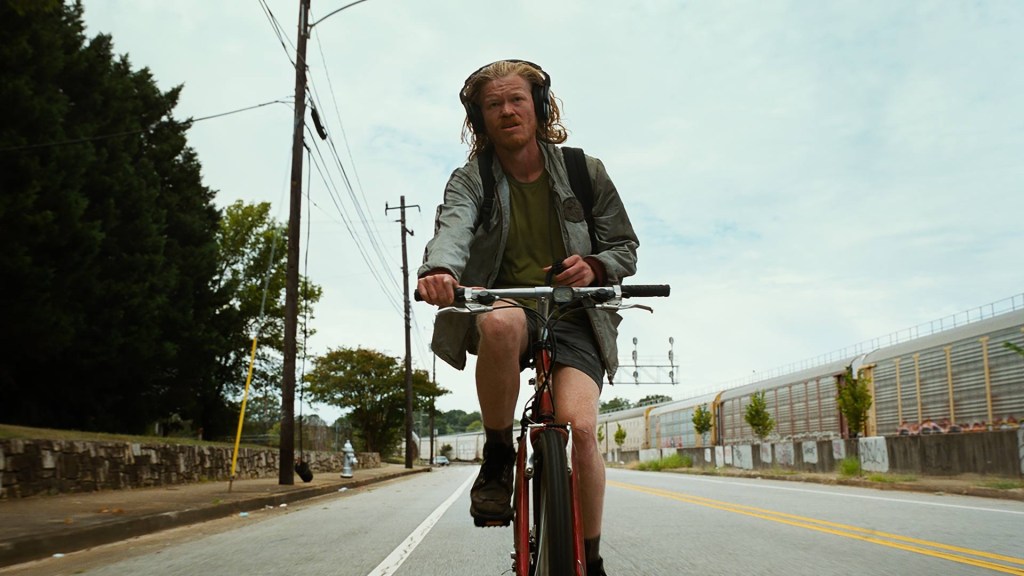
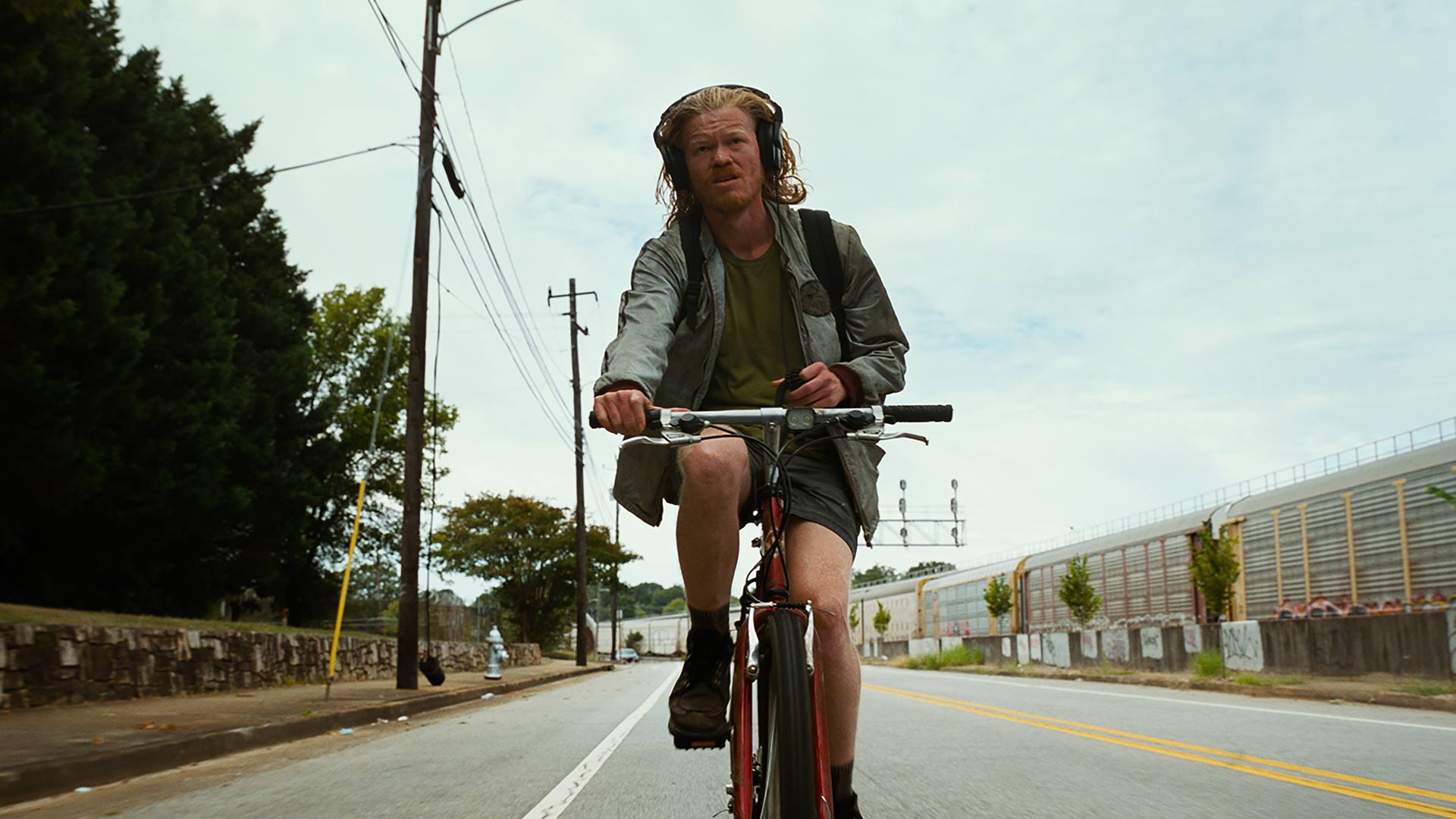
The sheriff subplot makes this failure impossible to ignore, and it begins earlier than the film wants you to remember. The first time we see the sheriff, he pulls Jesse Plemons’s character over while he is riding a bicycle. He is already disheveled, already presenting as unstable, already having committed what appears to be a serious crime. The moment carries genuine tension. It feels like the story is about to acknowledge consequence. Instead, the tension evaporates. The sheriff knows him. He is oddly apologetic, strangely familiar, asking vague questions about Plemons’s mother and well-being. Nothing is stated outright, but something is clearly wrong.
When the sheriff later comes to Plemons’s house to do actual detective work, it follows a violent struggle inside. Emma Stone’s character attacks Plemons and nearly escapes before Ron, a slow-witted, emotionally dependent man who has been assisting him throughout the film, intervenes and knocks her unconscious with the butt of a gun. Plemons, now stabbed in the arm, goes upstairs to deal with the sheriff, whose unease has turned into scrutiny.
This is where the film finally articulates what it has only circled before. In a halting, evasive confession, the sheriff implies without naming it outright that he molested Plemons as a child while babysitting him. He apologizes. He insists he was “fucked up back then.” He insists it happened once. He insists it never happened again. The meaning is unmistakable.
And then, astonishingly, the film lets it drift.
Rather than interrogating the enormity of what has just been admitted, the scene diffuses. Plemons is focused on one thing: getting the sheriff out of his house. He would be satisfied if the man simply left. The conversation slides into banal territory, even bees, and Plemons convinces the sheriff to step outside to see the apiary. The confession remains suspended, unexamined, stripped of consequence.
While they are outside, a shotgun blast erupts from inside the house. Ron has killed himself in the basement, where he was supposed to be guarding Emma Stone. Blood explodes across her face and body. She screams in genuine terror and shock, hysterical, human, convincing. In that moment, the film fully commits to her humanity. We believe it.
The sheriff hears the gunshot and instinctively turns back toward the house, toward consequence, toward whatever truth has finally surfaced. He never gets there. Jesse Plemons kills him from behind.
Not as justice.
Not as reckoning.
But to preserve his ability to continue the delusion he is committed to.
Afterward, Emma Stone speaks to Plemons almost immediately, despite having been covered in blood moments earlier and despite the horror she has just witnessed. At the time, this registers as shock, survival, dissociation. All are recognizably human responses. Only later, once the film decides the nonsense is literal, are we invited to reinterpret the moment retroactively.
And this is the problem.
The film does not build meaning forward. It rewrites meaning backward. It earns emotional reality in the moment, then destabilizes it later without discipline. Is she human? Is she alien? Is it allegory? Is it literal? The film wants all of these readings without committing to the responsibility of any one of them. Ambiguity is not sustained. It is revised.
For a brief stretch near the end, “Bugonia” almost stumbles into coherence. The hidden room, the obsessive documentation, the psychological decay suggest that the alien narrative might be delusion or projection, a desperate attempt to impose cosmic meaning on personal damage.
This would have been the movie.
Instead, Lanthimos does the laziest thing imaginable. The bullshit is real. The aliens are real. The conspiracies are real. The dream imagery is real. The delusion is validated rather than interrogated.
And in that moment, the film commits aesthetic suicide.
By literalizing the metaphor, “Bugonia” drains itself of tension, psychology, and consequence. Once the nonsense is canon, nothing matters. Character does not matter. Choice does not matter. Interior life does not matter. The film trades ambiguity for validation, not as provocation but as escape. This is the recurring failure of a certain strain of prestige cinema: the belief that making the metaphor literal deepens it. In reality, it flattens complexity into trivia and replaces inquiry with confirmation.
At times, the film plays like an aborted attempt to hybridize traditions that demand rigor. It feels as if Lanthimos wanted to make a Hitchcockian suspense picture filtered through Antonioni’s alienation but used a mumblecore script that mistakes underwritten dialogue for existential weight. Hitchcock understood cause and effect. Antonioni understood absence and duration. “Bugonia” offers neither. It gestures toward menace without mechanics and toward alienation without interiority. It wants the authority of classic cinema with the casual indifference of an improv, as if narrative discipline itself were something to be embarrassed by.
That is the fatal mismatch. You cannot graft mumblecore logic onto a thriller framework and call the resulting incoherence art. Hitchcock demands stakes. Antonioni demands thought. “Bugonia” supplies vibes.
What makes this so frustrating is that the craft is there. The performances are there. The control is there. This is not the work of an amateur. It is the work of a filmmaker with immense freedom choosing to indulge a script that confuses withholding with intelligence and weirdness with insight. By the end, the exhaustion is total. Not mystery. Not dread. Just the hollow realization that talent has been spent animating conceptual emptiness.
“Bugonia” is a hard pass.


Leave a Reply