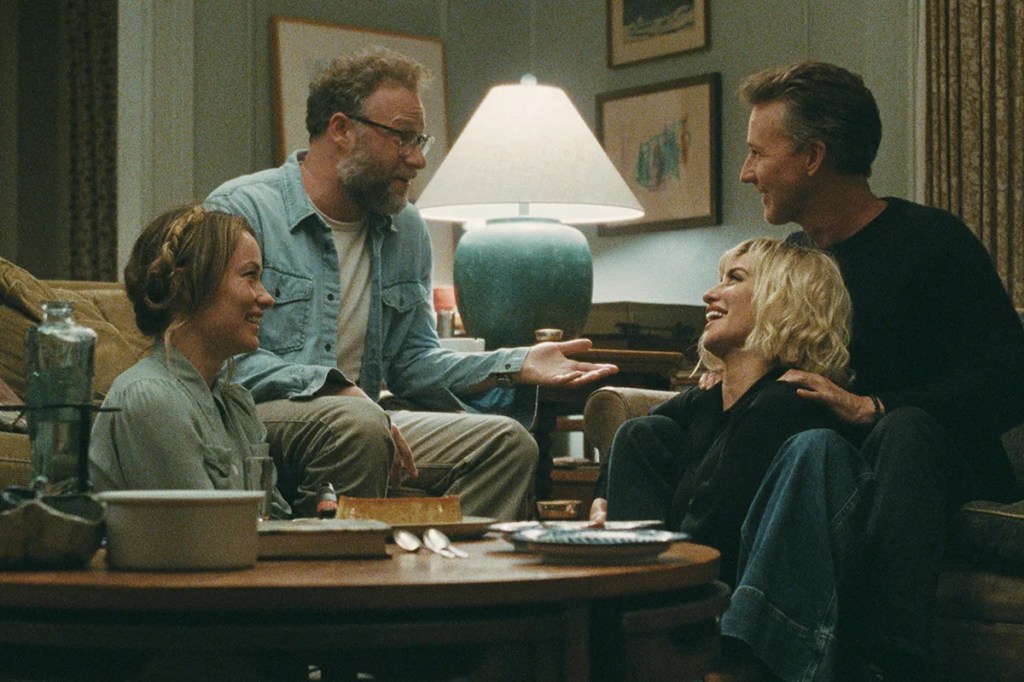
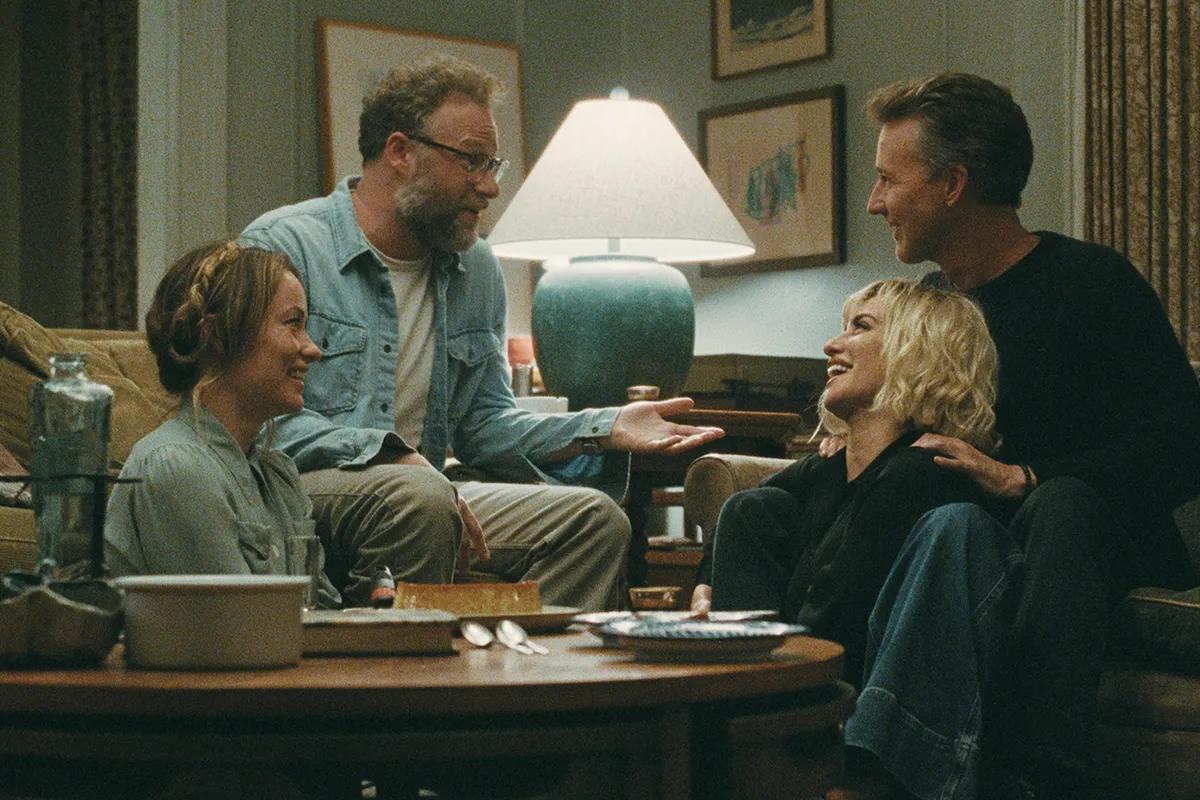
There’s a maxim in art: less is more. That doesn’t mean more is inherently worse. Plenty of great art is maximalist. The question is whether the more earns its keep. In Olivia Wilde’s The Invite, it rarely does — especially where close-ups of Olivia Wilde are concerned.
More music. More cutting. More mugging. More design. More eccentricity. More attempts at shocking the audience with “sexual frankness.” More revelations. More monologues. More fucking everything except any fucking. And somehow, after 107 minutes of more, there is considerably less of the one thing the movie desperately needs: believable human behavior.
The Invite is interesting because nearly every choice has been made in the direction of sophistication, prestige, relevance or taste, and nearly every one conspires against the movie becoming sophisticated, relevant or tasteful. It desperately wants to be an original film. Unfortunately, it feels like remade content.
And remade is literal. The Invite is an American adaptation of Cesc Gay’s Sentimental, released internationally as The People Upstairs, which Gay adapted from his own play. The American screenplay is by Rashida Jones and Will McCormack. The property has since been remade repeatedly around the world.
What is this, Death of a Salesman?
I’ve seen Gay’s Truman. It’s wonderful. I’ve watched the trailer for The People Upstairs because the film itself is not readily available in the United States. And even without subtitles, in 96 seconds you can immediately see a filmmaker who knows how to frame actors, trusts performance and understands rhythm.
Whatever Gay’s film ultimately is, Wilde is responsible for the movie she made. If you relocate a story, make the behavior work in the new culture. If you’re changing the title, setting, tone and so much else, why remake it at all?
Write a new movie. Stop being lazy.
Two couples, one apartment, one dead marriage, one sexually liberated relationship, jealousy, resentment and wine are not proprietary technology. People have been writing variations on this since before there was writing. Somewhere on a cave wall, there’s probably an outline for a four-banger about two couples fucking up each other’s lives with attempts at an orgy.
That is part of what makes The Invite so emblematic of the moment. It is not quite a remake and not quite an original. It is a remake of a concept.
What the movie seems never to have considered is subtraction. Actors do this all the time: keep what serves the character, strip away what doesn’t, add only what the character requires. Adaptation demands the same discipline. Instead, The Invite adds time, style, menace, eccentricity and meaning until you can barely see the simple mechanism it inherited. It didn’t deepen it. It piled on.
That makes Wilde’s description of The Invite as a love letter to Cassavetes, Mike Nichols, Paul Mazursky, Woody Allen, Billy Wilder, Nora Ephron and Agnès Varda especially strange.
That is quite a fucking love letter.
Those filmmakers didn’t simply have different visual styles. They had different ideas about what movies were. Cassavetes chased behavior. Mazursky trusted ordinary moments. Nichols understood escalation. Allen absorbed European cinema and translated those influences into an American language that became completely his own.
Husbands and Wives clearly has Scenes from a Marriage somewhere in its DNA, but it is not Bergman transplanted to Manhattan. It is unmistakably Woody Allen. Knowing the surfaces of serious adult cinema is not the same as understanding what makes those movies work.
And before any of that can work, you need a screenplay.
A screenplay is a blueprint. If your blueprint tells you to build a shanty, you can arrive with beautiful lumber, expensive fixtures, Penélope Cruz and a production designer with exquisite taste, and you are still building a shanty.
Joe, played by Seth Rogen, is a miserable music teacher with a bad back. He once had some success as a musician but now considers himself a failure. He lives with his wife Angela, played by Wilde, in an enormous, immaculately designed San Francisco apartment.
Joe inherited it. He was literally born there. The movie wants us to understand that he is embarrassed because he and Angela could never otherwise afford to live there. Except they bought the apartment next door, broke through, renovated, furnished it beautifully and rebuilt a bathroom with expensive new tile chosen specifically to resemble the vintage original.
At some point, just be fucking rich. Who cares?
The film wants the pleasures of wealth while apologizing for the characters having it. Every frame contradicts the screenplay’s insistence that they can’t really afford this life. The visiting couple clocks it immediately: Are you rich? Yes. Obviously.
Wilde has said San Francisco is essential to the film, that it is in the movie’s DNA. Why? If I move this apartment to New York, Boston, Chicago, Seattle or Portland, what breaks? If San Francisco is essential, the movie has to make me feel why.
The apartment itself is beautifully designed. It is also so aggressively designed that eventually you want it to get an agent. Every tile matters. Every rug matters. Every shade of paint matters. Angela eventually dresses in colors that visually harmonize with the apartment, suggesting that she has somehow disappeared into the domestic world she created.
Fine. Except Angela has not disappeared into anything. She controls the apartment, arranges the dinner, invites the neighbors, controls Joe and is the loudest, most domineering presence in the room. The visual metaphor says she is invisible. The screenplay says she controls everything. The performance makes damn sure you never forget she is there. Pick one.
Joe and Angela also have a 12-year-old daughter, conveniently elsewhere for the evening. I know they have raised a child together because the screenplay tells me so. I do not feel it. There is no parental shorthand, no accumulated family behavior, no sense that another person has occupied the space between them for twelve years. Instead, Angela gives us information about having vetted the house where the daughter is sleeping.
Motherhood by exposition.
That matters because The Invite begins at approximately eight, races toward eleven, eventually collapses somewhere near one or two and expects my heart to register six. The emotional math doesn’t work.
Gay’s Sentimental runs 82 minutes. The Invite runs 107. Length alone isn’t the problem. The Invite feels both rushed and bloated.
Then the neighbors arrive.
Piña, played by Penélope Cruz, is a psychotherapist and sexologist, vegan, bisexual, bilingual, sexually liberated and apparently unable to smoke more than one hit of marijuana without compulsively counting things. Hawk, played by Edward Norton, is a retired fire chief, rug connoisseur, interior-design enthusiast and Rolfer.
Real people are weird. That isn’t the problem. The problem is that every detail arrives carrying a little sign that says CHARACTER DETAIL. Nothing emerges. Everything is assigned. Eccentricity is not characterization.
Cruz is wonderful, which makes her casting especially odd. If you are already beating us over the head with Woody Allen as an influence, perhaps don’t cast Penélope Cruz as a sexually voracious Spanish woman who moves between English and Spanish and discusses her attraction to women. At some point, she starts to feel like a Vicky Cristina Barcelona plant. The film cannot stop showing us what it has seen.
Norton does better because he understands how not to attack a joke. Seth Rogen is the best thing in the film by a mile: the funniest, the most natural and frequently the only actor who doesn’t seem to be demonstrating something.
Wilde has invoked Albert Brooks when discussing Rogen. There is a lineage, but Rogen doesn’t need to be Albert Brooks or enter some newly discovered dramatic phase. He has been good for decades. Here, his naturalism is a relief. Rogen does less. The movie desperately needs less.
Which brings us to Wilde, the weakest performer in the film by a considerable margin. That becomes an especially serious problem because she also directed the movie and cast herself. Actors directing themselves isn’t the problem. Judgment is.
Angela is intended to occupy the tradition of the neurotic comic heroine. The film is even dedicated to Diane Keaton. But you cannot become Diane Keaton by playing neurotic. Neurotic is not frantic movement, widened eyes or a collection of external choices. It is like playing drunk: the better performance is often the drunk person desperately trying to appear sober. Resistance creates behavior.
Wilde announces the neurosis. Then underlines it. Then the camera moves closer. The camera loves Angela. The performance does not benefit from the scrutiny.
Then there is the score, which is hysterical. Not funny hysterical. Hysterical as in you keep expecting someone with a butcher knife to emerge from the hallway. The music repeatedly puts you into the psychological state of a Hitchcock thriller while the characters are talking about rugs, marriage and Joe’s back.
Norman Bates is not upstairs. Hawk is Rolfing.
The opening works from the same impulse: stylized panels, retro imagery, cutting, music, San Francisco. Before we know anybody, the movie is already announcing itself.
Look. Cinema. Style. Taste. References.
It is aesthetic throat-clearing.
This is where Wilde’s list of influences becomes more than merely irritating. The issue is confusing recognition of the signifiers with understanding of the machinery.
Four people in an apartment is not Cassavetes. Handheld photography is not Husbands and Wives. Penélope Cruz speaking Spanish about sex with women is not Vicky Cristina Barcelona. A dedication to Diane Keaton does not make Angela Annie Hall.
Then the second half reveals the true purpose of the invitation. The upstairs couple has sex parties. They are sexually open. Piña enjoys pegging Hawk. They invite Joe and Angela into their world. Once again, the movie mistakes vocabulary for insight.
There is nothing inherently shocking about pegging, bisexuality, polyamory or sex parties. Saying the words is not the same thing as being frank about human beings.
For all the sex The Invite talks about, there is essentially no sex. Everybody finally gets to the threshold, and then fucking Joe and his bad fucking back ruin everything. Fortunately Hawk is a Rolfer.
Chekhov’s Rolfer finally fires.
More damaging is Joe’s emotional reversal. He discovers Angela has repeatedly walked naked in front of the window knowing Hawk could see her. She liked being watched, so she continued. Joe is humiliated and enraged. Then almost immediately he is prepared to sleep with Piña while Angela potentially sleeps with Hawk.
What changed? Nothing. The next scene required a different Joe. That is not character development. It is repositioning furniture.
Then come the scheduled disclosures: Hawk is really Howard. Dead wife. Cancer. Joe’s failure. Angela’s pain. Piña’s turn. Everybody steps forward for the emotional recital. Monologue time.
Cassavetes wants behavior. Mazursky wants contradiction. Nichols wants accumulation. The Invite wants explanation.
The solution was never more. It was less. The Invite never builds. It changes volume. Its 107 minutes don’t deepen the people. They dilute the mechanism.
And that finally brings us to prestigious nonsense.
Prestigious nonsense is when a movie mistakes the indicators of sophistication for sophistication itself: the right cast, the right apartment, the right city, the right sexually provocative vocabulary, the right neuroses, the right references.
Everything has been selected to signify taste. But taste is something I should feel. Instead the movie tells me, scores what it told me, cuts to the reaction and pushes in.
Maybe what The Invite needed most was one authoritative person willing to say no. No more music. No more close-up. No, Joe cannot go from murderous jealousy to partner-swapping enthusiasm in five minutes. No, Angela cannot simultaneously be invisible and dominate every room.
No. Less.
The greatest irony is that Wilde says she made a love letter to all these filmmakers. I think she ultimately made a love letter to the movie she imagined she had made.
A real influence disappears into the work. You shouldn’t still see the shipping labels. A real auteur transforms someone else’s material until it becomes unmistakably their own.
The Invite wants to be smart, sexy, sophisticated, outrageous, European and American, a love letter and an original. It wants very badly to be cinema.
There is a perfectly good movie hiding somewhere inside the premise: four people, one apartment, one dying marriage, one apparently healthy relationship, jealousy, sex, resentment, wine and one increasingly terrible night.
That is enough.
You need four good actors, a good script and a director with enough confidence to leave them alone until something real happens. Instead, we got The Invite.
Variety compared it to Who’s Afraid of Virginia Woolf? and vintage Woody Allen. In the end, perhaps they were right. In that it has none of the wit of the former and none of the charm of the latter.


Leave a Reply